Payday Loans vs. Installment Loans: Which Short-Term Financing Option Is Better?
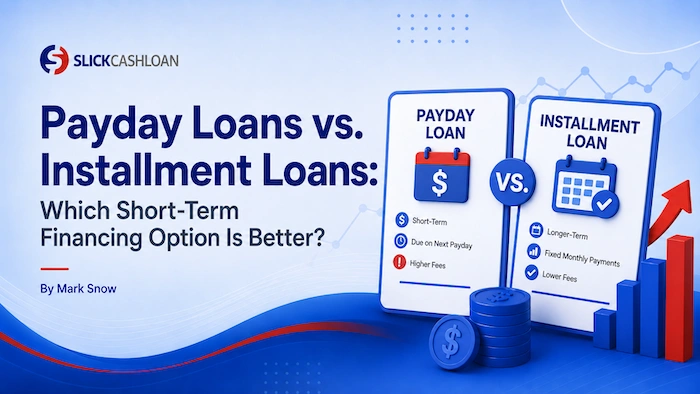
Installment loans generally offer the best short-term funding options when you have a longer period to pay back, desire fixed payment amounts, and wish to build positive credit. If you just need to borrow some money for a short period (less than a month) and get paid soon, then a payday loan may be faster and/or easier as you will only have to repay all borrowed funds in one lump payment at or before your next payday.
The choices made regarding which loan to apply for (payday or installment) affect your repayment schedule, cost of borrowing, total dollar amount that you may borrow, your credit history requirements and your overall financial well-being. The most suitable loan product for you is based upon how much additional cash you require, if you can successfully repay the loan, and how quickly you need the funds.
Below is a practical comparison of payday versus installment loan characteristics to assist you with making an educated borrowing choice.
Payday Loans vs Installment Loans: How They Compare
The primary difference between these two types of financing lies in how you repay them; payday loans are paid back as a single payment, typically when the borrower receives their next paycheck.
Installment loans are repaid by making the same amount each month, which may be a flat rate or an equivalent portion of the total loan balance.
Both payday loans and installment loans can provide temporary relief from unexpected expenses. However, both should be viewed differently because of the varying characteristics of these types of lending. Most payday lenders will accept borrowers that have poor or no credit, whereas many installment lenders perform some type of underwriting (a process of evaluating an applicant’s creditworthiness).
Stated simply, payday loans compared to installment loans can best be described as being about speed and ease of accessing funds versus cost and budgeting.
Repayment Terms and Schedule
Repayment structure is the most significant difference between these loan types.
Payday Loan Repayment
Most payday loans have a large payment that comes due at the end of two to four weeks after borrowing; this payment will include all costs (fees + interest) for the loan as well as the original amount borrowed.
Most payday lending institutions need direct access to your checking account either through automatic withdrawals or by having you write them a post-dated check. The danger of overdraft charges occurs when you don’t have sufficient funds in your account to cover both the original amount borrowed and any additional fees when the loan comes due.
Payday loans may also create long-term financial problems because the lender requires you to repay everything you borrowed from them as well as all associated fees and interest in a short period of time. When individuals cannot make the payments required of them to avoid rollovers, many become trapped in an endless cycle of debt with the possibility of repeated rollovers creating excessive additional fees.
Installment Loan Repayment
Installment loans are generally paid back in installments over a longer time frame, typically via fixed monthly repayments for anywhere between a number of months to a couple of years. The majority of short-term personal installment loan choices may range from a few months up to 12 months. Larger personal loan choices will often have longer loan periods.
The general rule is each repayment will be made up of a portion of the outstanding principal plus interest. By doing this, it enables borrowers to pay off their debt in smaller installments rather than having to pay all at once.
In addition to offering easy-to-budget with repayments many installment loans also provide an opportunity for early pay-off. If you’re able to pay your loan balance early you’ll likely save money on the overall interest rate charges as long as there’s no early payoff penalty.
Interest Rates and Borrowing Costs
Cost differences between loan types can be substantial and impact your financial well-being.
Payday Loan Costs
Most of the interest rates for payday loans are at least as high as 400% APR and could likely be considered among the most expensive ways to borrow money. Borrowers using payday loans will find that their interest rates may go as high as 400% APR and therefore these types of loans could further increase the borrower’s overall financial problems.
Payday loans commonly charge borrowers a flat fee for each payday loan rather than charging borrowers an interest on their payday loans. Generally speaking, this type of fee could be anywhere from $15 to $30 per every $100 borrowed. If you borrowed $300 with a $20 flat fee for every $100 borrowed your fees would be $60, so you may owe $360 approximately two weeks after the initial loan was made.
In many areas of the United States, the annual percentage rate (APR) for payday loans could be considerably higher. In Texas, payday loan APRs have been reported to be very high, often several hundred percent. Therefore, in a very short time frame, borrowers may owe several times more than they borrowed when taking out a payday loan.
Rollover fees can make the total cost even worse. Many borrowers who take out payday loans do not have the means to repay them by the due date, leading to a cycle of borrowing that can result in escalating debt and financial instability.
Installment Loan Costs
Installment loan APRs vary widely depending on the loan type, lender, and borrower credit profile. Installment loans APR’s are much lower compared to what you would see on a payday loan. Typically, individuals with good credit will be able to get an installment loan at a better interest rate, whereas, people who have poor credit will likely obtain higher interest rates.
While there could be additional charges associated with an installment loan like origination fees, late fees, returned payment fees etc., most installment loans have far clearer repayment terms. This allows the borrower to view each month’s payment amount along with the length of time they have to repay the loan and how much money the loan will ultimately cost them prior to accepting the loan.
Although interest on an installment loan does build up over several months to years, the APR’s of an installment loan are generally significantly lower than those of a payday loan. This means that for many consumers, it can also result in lower costs over all as well as fewer problems in terms of having to make timely payments.
Loan Amounts and Approval Requirements
The application process and loan limits vary significantly between these options.
Payday Loan Limits and Approval
Payday loans are generally small, short-term loans, while installment loans can range from modest amounts to much larger sums depending on the lender and borrower qualifications. Payday loans are generally small-dollar loans, whereas installment loans are available in much larger amounts, with some lenders offering up to $100,000 depending on qualifications.
Payday loans are generally easier to access than installment loans due to the fact that they do not require credit checks and minimal application requirements; therefore, allowing people with poor credit to obtain funds quickly. Payday lenders often ask for proof of identity, proof of income, and an active bank account.
The application process for payday loans is generally quick and straightforward, often requiring only proof of identity and income, while installment loans usually involve a credit check and more detailed financial information. Many borrowers can apply online, though some payday lenders also operate in store.
Installment Loan Limits and Approval
The repayment term of an installment loan is generally for multiple months to years. Therefore, borrowers can borrow a much greater amount of money in comparison to the short-term nature of a payday loan that is paid back upon the borrower’s next payday. Borrowers using SlickCashLoan’s lender network may have access to loan options of varying amounts, depending on the lender and loan type.
Most installment loans require a credit check before they can be issued; therefore, they are not as easily accessed by borrowers who do not have good credit. Payday loans are intended to be available to a wide variety of credit situations, but there are still online lenders that provide installment loans for people with bad credit. The interest rates associated with these types of loans are also generally higher than the interest rates associated with good-credit customers.
Many installment loans are unsecured, so collateral is often not required There are exceptions. Some secured loans may use a vehicle or savings account as collateral and provide different terms regarding payment.
Because many lenders review an applicant’s job status, income, debt obligations, and credit history for installment loans, approval times are often longer than those for payday loans. Many online lending companies can fund their approved applicants within one to two business days.
Credit Impact and Building Credit History
How each loan type affects your credit profile differs considerably.
Payday loans generally do not report positive payment history to credit bureaus. As such, making timely payments of payday loans will generally have no impact in building your credit history. Conversely, failure to make timely payments of payday loans could potentially negatively affect your credit if the account is sent to collection agencies.
Installment loans will report your payment history to credit bureaus. Therefore, timely payment of an installment loan can aid in either improving or establishing a borrower’s credit score. The ability to consistently pay each scheduled payment on-time can demonstrate a stronger payment history and ultimately help a borrower develop a better credit profile over time.
Despite these benefits there are potential pitfalls. There is a risk that applying for an installment loan may be subject to a hard credit inquiry. Further, missing payments on an installment loan can result in damage to your credit score.
Financial Situation Considerations
Your current financial circumstances often determine which option makes sense.
Payday loans are best used when the amount needed is very small, you need it right away, and you have a way to pay back the full balance with all the fees included in your next paycheck. A good example would be needing some extra cash fast for an emergency bill and knowing that your next check will be enough to take care of the entire bill plus any additional fees you incurred and your normal monthly expenses.
If you need a larger amount of money, prefer making monthly payments on debt rather than paying off the debt entirely at once, or do not feel safe paying the entire amount due at once then installment loans might be the better option. In many cases, especially where there are unexpected expenses (such as vehicle repair, medical expenses, etc.) that need longer periods of time to be repaid, installment loans are a better choice.
Payday Loans vs Installment Loans: Which Should You Choose?
Only use payday loans for small emergency situations up to $500 that you will be able to pay back on your next payday. While payday loans can provide immediate access to money, most payday loans have high costs associated with them and are at risk of becoming costly debt if the entire balance is not repaid in a timely manner.
Use installment loans for larger amounts, when repayment time matters, or building credit matters. An installment loan may include lower interest rate options, fixed payments and more manageable payment options compared to payday lending.
When using either payday loans or installment loans, responsible lending practices are important. Borrow only what you require, verify that you have the ability to make timely repayment of the loan and compare multiple lender options before accepting a loan from one of those lenders.